Letter 09 · Catalog
What's your song actually worth?
A plain-English breakdown of how a song gets paid, how a catalog gets priced, and how Catalog and Maude show you yours.
Chuka Chase
Co-founder, Symphony
October 2026
Ask an artist what their biggest song is worth and you'll usually get a pause, then a guess.
That's not a knock on artists. Nobody hands you the math. The money from one song comes in through four or five doors, on different schedules, in statements written for the people sending them.
Three stories worth knowing
TLC sold millions of copies of CrazySexyCool. Their 1991 deal paid about 60 cents an album after deductions, according to the LA Times. T-Boz later said the album made about $75 million for the label and each of them got about $50,000. They filed for bankruptcy in 1995 and used it to renegotiate.
Lil Nas X bought the beat for "Old Town Road" as a $30 lease with limited distribution rights. When the song blew up, he and the producer, YoungKio, signed a new agreement, and YoungKio says his contract gave him 50% of the publishing. What it was worth lived in the paperwork.
Taylor Swift's first six albums were sold in 2019 inside a roughly $300 million deal for her old label, and she said she never got a shot at buying them. In May 2025 she bought them back for about $360 million, per Billboard's sources, for albums Billboard estimated were bringing in around $60 million a year.
How one song gets paid
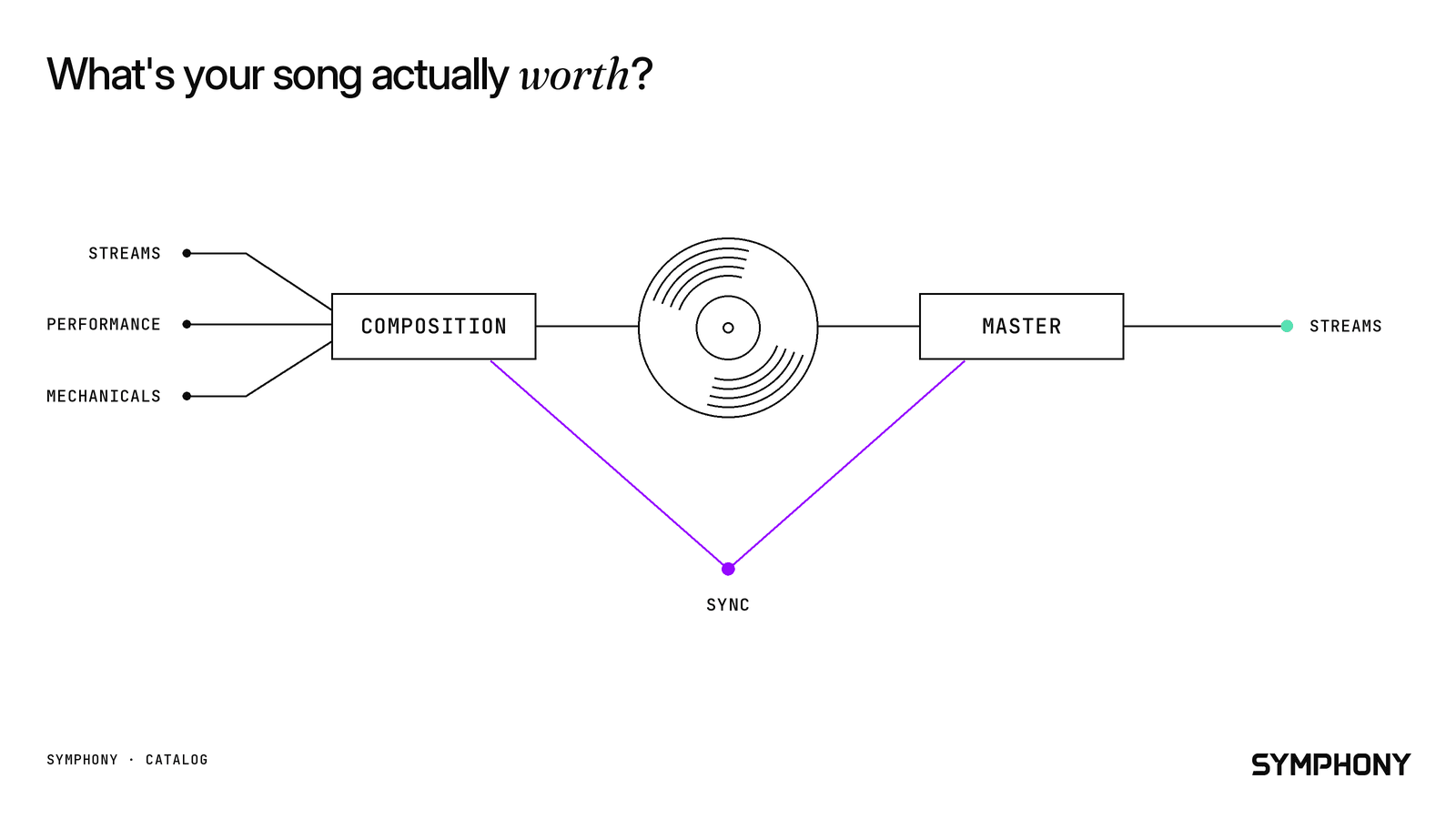
Every recorded song is really two copyrights: the composition (melody and lyrics) and the sound recording, the master. They're owned and licensed separately.
The master earns when people stream or buy the recording, and that money goes to whoever owns it.
The composition earns publishing. Performance royalties come through a PRO like ASCAP or BMI. Streaming mechanicals in the US come through the MLC. Publishing income is usually split into a writer's share and a publisher's share, half and half.
Sync is a song landing in a show, an ad or a game. It needs a license for both copyrights, so it can pay both sides.
And some of it never finds you. In 2021 the MLC received about $424 million in streaming royalties that services couldn't match to an owner.
How a catalog gets a price
Catalogs mostly get priced as a multiple of what they net each year. Billboard reported the common range was about 10 to 12 times net publisher's share, with deals pushing past 16 times during the boom.
So say a catalog nets $50,000 a year. At 10 times, that's a $500,000 conversation.
Older songs are growing right now, too. Music Business Worldwide found that songs more than three years old took 42.6% of US Spotify Top 200 streams from January to September 2026, up from 28.4% a year earlier.
Why we built Catalog
In September we started posting Maude's math on big songs: who wrote it, who owns the recording, roughly what each side earned. The one on Adela's "Nicole Kidman" is at 24,170 likes and 384 comments on Instagram as of Oct 20, more likes than the account has followers. The comments are people working out the mechanics. "It took 6 writers to come up with these lyrics?" One called it "the exact reality check every indie artist needs." Another explained that a major label is "like a bank." Some just typed MAUDE to run it on their own songs.
That curiosity is a big part of why I wrote this, and why we built Catalog. You can't price what you can't see. Labels kept asking for one place to watch their catalog move, every song's streams next to the TikTok and Instagram sounds using it. A 2022 album track starts climbing on a Tuesday because a creator put it under a video, and by the time anyone notices, the moment's half over.
What Catalog and Maude actually do
Turn Catalog on and every artist and live track loads from Spotify and gets tracked daily. Each song shows streams, growth over the last 28 days, TikTok and Reels creates and its Spotify popularity score.
Maude, our business affairs agent, finds the TikTok and Instagram sounds using your music, fan-made originals included, and asks you to confirm which are yours before she tracks them.
Every day she reads the roster for thirteen kinds of movement, like an older cut waking up, a creator post taking off, an editorial add or a Shazam spike. Open one and you get the last 30 days against the song's normal day, the post that started it with its views, and four options: share it, open the song, boost the post or find creators. Nothing runs until you say so.
She's careful about cause. She checks for a release first, and treats a playlist add as something that amplified a song, not what started it. Four times the usual day is real. A two times bump is probably noise. When the data isn't complete, or she can't tell what drove it, she says so.
Then there's the money side. Maude reads what your distributor, publisher and PRO send you, checks every line against what you should be paid, and ranks the gaps by dollar impact. She checks split sheets and runs the forecast forward. One artist in LA has her double-check every statement, and in the first quarter she caught that Facebook was missing from the statement entirely.
When something's worth acting on, she hands it off. Simmy runs ads, Sage briefs creators, Cue handles the release and Echo emails your fans.
Who it's for
Labels, managers running a roster, and artists sitting on a real body of work. Catalog is part of Symphony Advanced, $250 a month per artist, which also adds social watching and Creators (more on that soon).
If that's you, book a demo at symphonyos.co/demo and we'll load your roster before the call.
Most artists find out what a song was worth after somebody else already priced it. I'd rather you know first.
Cheers, Chuka